


Every couple who lands on your website is running the same silent checklist, whether they could name it or not. They’re not reading your About page for fun. They’re comparing you — often against four or five other photographers open in other tabs — and deciding, fast, whether you’re the one who understood the day before it happened.
Your website’s job isn’t to describe your work. It’s to answer the questions a couple is already asking, in the order they’re asking them, before they have to ask you directly. Here are the eleven that matter most — and what happens when a site leaves them unanswered.
1. “Does this photographer understand weddings like mine?”
This is the first, fastest question, and it’s answered almost entirely by your hero image and your first gallery — not your words. A couple planning an editorial, fine-art wedding will scroll past a site full of bright, candid shots without registering it as relevant, even if the photographer is technically excellent. Your homepage needs to lead with the work that represents the couple you actually want to book, not a broad sample meant to appeal to everyone.
2. “Is this within my budget, roughly?”
Couples don’t need exact numbers on the homepage, but a website that gives zero indication of investment level — no “starting at,” no collection tiers, nothing — forces every single inquiry to open with a budget question instead of a fit question. That slows down your process and invites comparison shopping from couples who were never going to be a match.
3. “What will my actual wedding day look like with this photographer there?”
This is where process matters more than most photographers expect. A short, specific description of what the day-of experience feels like — how present you are, how you move through a timeline, what a couple can expect from you emotionally, not just technically — answers a question that pure portfolio images can’t.
4. “Can I trust this person with the most important day of my life?”
Generic testimonials (“amazing to work with!”) do very little here. What builds trust is specificity — a couple describing a particular moment you captured, a particular way you made them feel calm during a stressful part of the day. One specific testimonial outperforms five vague ones.
5. “What’s included, and what happens after I book?”
Couples want clarity on collections, delivery timelines, and what the actual process looks like from deposit to gallery delivery — not because they’re negotiating, but because uncertainty about logistics creates hesitation even when they love the work.
6. “Do they photograph weddings like mine — venue, culture, size, season?”
If you shoot a range of wedding types, your website needs to make that range visible, not buried in a single mixed gallery. A couple planning an intimate elopement and a couple planning a 300-guest ballroom wedding are looking for different visual proof, even from the same photographer.
7. “Is this website actually current?”
An outdated blog, a “2023 collections” page, or stale copyright year in the footer quietly damages trust even when the photography itself is timeless. Couples read a stale website as a stale business, whether or not that’s accurate.
8. “How do I actually reach them, and what happens next?”
This sounds obvious, but it’s one of the most common gaps we find in photographer websites: unclear next steps. A contact form with no explanation of turnaround time, or a page with three different ways to reach out and no guidance on which to use, creates hesitation at the exact moment a couple was ready to inquire.
9. “Does their style hold up across an entire gallery, not just the best nine images?”
Instagram shows a couple your best nine photos. Your website is where they check whether that quality holds across an entire day — getting-ready shots, the ceremony, the reception, the quiet in-between moments. A gallery that thins out in quality past the highlight reel undercuts everything the homepage promised.
10. “What are other people saying, specifically?”
Beyond testimonials, couples increasingly check for third-party validation — press features, other vendors’ recommendations, or a “as seen in” strip. This doesn’t need to be extensive, but its presence (or absence) registers as a trust signal even when a couple doesn’t consciously notice it.
11. “What’s the one thing I should do next?”
After all of that — after she’s scrolled the galleries, read the process, checked the pricing signal — the website needs exactly one clear next step. Not a form, a phone number, an email address, and a “follow along on Instagram” link competing for her attention all in the same section. One door, clearly marked, repeated at the top and the bottom of the page.
What This Means for How Your Website Is Actually Built
Notice that almost none of these eleven questions are answered by better photography alone. They’re answered by page order, by specificity in the words around the images, and by removing friction at the exact moment a couple is ready to reach out. This is precisely the structure built into our photographer-specific Showit templates — Melissa, Isabella, and Claire — each one built so these eleven questions get answered in the sequence a couple is actually asking them, rather than in whatever order felt visually appealing during setup.
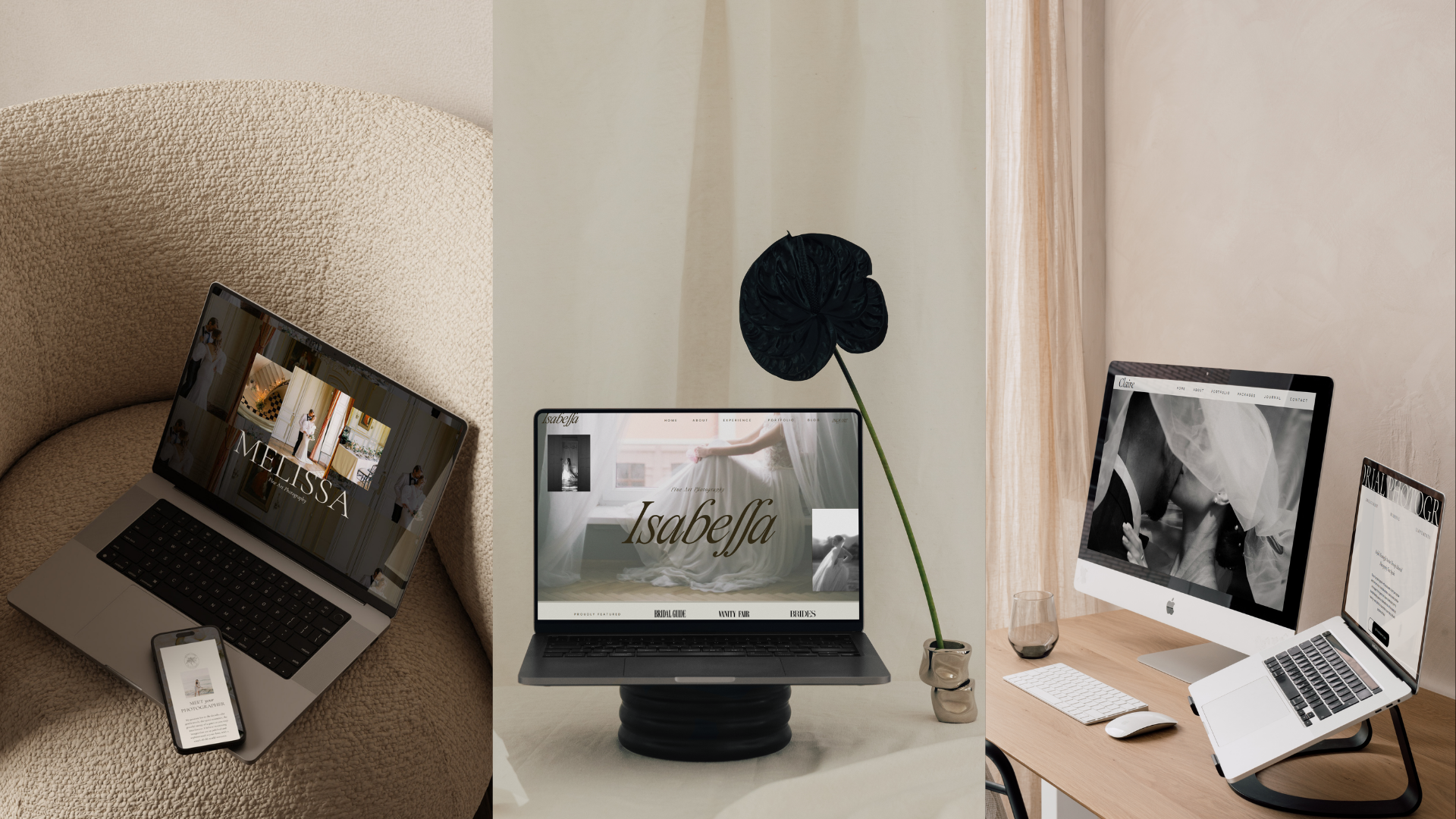
Curious whether your current website answers all eleven? See the Melissa, Isabella, or Claire template live and preview your own galleries inside it.
Frequently Asked Questions
What’s the single most important question my wedding photography website needs to answer? Whether you understand weddings like theirs. It’s answered almost entirely by which images lead your homepage — lead with the work that represents the couple you want to book, not a broad sample meant to appeal to everyone.
Should I put pricing on my wedding photography website? You don’t need exact numbers, but you should give some pricing signal — a starting-at figure or collection tiers. Zero signal forces every inquiry to open with a budget question instead of a fit question.
How many galleries should my wedding photography website have? Enough to show range if you shoot different wedding types (venue, size, culture, season), but each gallery should be curated, not exhaustive. A tightly edited 20-image gallery reads as more premium than an 80-image dump.
Do testimonials actually matter for a wedding photography website? Specific ones do. A testimonial naming a particular moment you captured or a particular feeling you created outperforms five generic “amazing!” quotes. Quality over quantity here matters more than almost anywhere else on the site.
How many ways to contact me should I show on my website? One clear, obvious path — not three competing options. Multiple contact methods without a clear primary path create hesitation rather than convenience.
 SAVE THIS POST FOR LATER






share this post